274%
Year-over-year revenue growth
A documented outcome from a Squires Media Group engagement, achieved through the integrated Squires Media Method across SEO, paid media, and attribution.
 Squires Media Group
 Squires Media Group
SEO plus GEO/AEO that win Google and AI search. Foundation/Pillar/VIP architecture built to compound authority and revenue. Get found in ChatGPT—call us.
Fortune 100 talent — without Fortune 100 overhead
Free strategy consultation · Response within 1 business day
 5.0out of 5 on Google Reviewson GoogleGoogle Partner
Search engines are no longer the only gatekeepers of discovery. AI assistants — ChatGPT, Gemini, Claude, Perplexity — now answer buyer questions directly, and the businesses that appear in those answers are earning trust before a competitor's website ever loads. Squires Media Group builds SEO programs designed to win on both fronts: technical and content architecture that compounds authority in traditional search, plus generative engine optimization (GEO) and answer engine optimization (AEO) that positions your business as the cited source when AI platforms construct their responses. One integrated system. Zero vanity metrics.
Built for: Marketing leader investing in long-term organic visibility
Definition
SEO and AI Search optimization is the practice of structuring a website's technical foundation, content architecture, entity markup, and structured data so it ranks in traditional search engines and surfaces as a cited source in AI-driven answer platforms such as ChatGPT, Gemini, and Perplexity; Squires Media Group delivers this through a Foundation, Pillar, and Velocity content framework.
The shift from keyword-driven search to AI-generated answers is not a future event — it is the current reality of how a growing share of buyers research professional and consumer services. When someone asks ChatGPT 'who is the best business attorney in Dallas' or Perplexity 'what should I look for in a home health provider,' those platforms do not return a list of blue links.
They synthesize an answer. They cite sources. They recommend businesses by name. The companies that appear in those answers are not there by accident — they are there because their digital presence was structured in a way that AI systems can read, trust, and surface.
For regional service businesses in competitive markets, this is a market-share event happening in real time. The firms investing in entity clarity, structured data, and answer-ready content today are building a position that compounds. The firms waiting are ceding ground to whoever moves first. Squires Media Group's SEO programs are engineered with both realities in mind — because building only for Google in 2025 is the same strategic error as building only for Yellow Pages in 2005.
The window to establish authority before your category is saturated is open. Clients who move now capture disproportionate share from those who wait.
Most SEO programs are a collection of blog posts optimized for individual keywords, stitched together without a structural logic. That approach produces traffic spikes, not compounding authority. The Squires Media Method is built on a deliberate three-tier architecture that mirrors the way both search engines and AI systems evaluate topical depth and site authority. Foundation pages establish the core identity of the business — what it does, where it operates, and why it is credible — in the clearest possible terms for both crawlers and AI language models.
Pillar pages define expertise at the service-category level, answering the full spectrum of questions a qualified buyer might ask about a given topic, with enough depth to be cited rather than skimmed. VIP pages — vertical, industry, and place pages — extend that authority across every meaningful market, service variant, and geography at scale, ensuring the business is discoverable wherever its buyers are searching.
Internal linking within this architecture is engineered rather than incidental: each link is placed to transfer authority intentionally, guide users deeper into the site, and signal thematic relevance to search and AI systems alike. The result is a site that reads — to Google and to Gemini — as the authoritative resource in its category, not one of many roughly equivalent options. That distinction is what drives durable rankings rather than rankings that evaporate when a competitor publishes a competing page.
Content quality is only half the equation. A technically flawed site — one with crawl errors, slow load speeds, ambiguous entity signals, or missing structured data — limits how well even exceptional content performs. Squires Media Group's SEO programs begin with a rigorous technical baseline: an audit of site architecture, crawlability, indexation, Core Web Vitals, schema markup, and entity definition.
Entity architecture is particularly consequential in the era of AI-generated answers. AI language models and knowledge graphs understand the world through entities — named people, businesses, places, services, and the relationships between them. A business whose digital footprint clearly defines what it is, where it operates, what it does, and who leads it is far more likely to be surfaced confidently in an AI-generated response than a business whose signals are ambiguous or contradictory across the web.
Structured data — implemented via schema markup in formats like Organization, LocalBusiness, Service, FAQPage, and BreadcrumbList — gives search engines and AI systems machine-readable signals they can act on with confidence. Citation consistency across directories, Google Business Profile, industry platforms, and third-party mentions reinforces those signals. Squires Media Group handles all of this within a single integrated engagement — not as an add-on, but as foundational infrastructure, because rankings built on a compromised technical base cannot hold at scale.
Generative engine optimization is the practice of structuring a business's content and digital presence so that AI language models — including ChatGPT, Claude, Gemini, and Perplexity — surface that business as a credible, citable source when generating answers to user queries. Answer engine optimization is its counterpart in traditional search: earning the featured snippets, People Also Ask placements, and knowledge panel positions that capture attention before a user ever scrolls to the organic results.
Both disciplines share a common foundation: content must be authoritative, well-structured, factually specific, and written in a format that AI systems can extract and quote with confidence. That means clear, declarative sentences. Defined terms. Answered questions within the body of the page, not buried beneath navigation.
Self-contained sections that stand alone as citable units. Squires Media Group writes and structures every page in the Foundation / Pillar / VIP architecture with these requirements embedded — not retrofitted.
The result is content that does not just rank in Google today but is positioned to be surfaced by AI assistants as the category shifts from link-based discovery to answer-based discovery. For professional service businesses in legal, healthcare, B2B, and home services — where trust and authority are the primary purchase drivers — being the cited source in an AI-generated answer is a distinct competitive advantage that traditional SEO alone cannot deliver.
Rankings are a means, not an end. The measure of an SEO program's value is not where a page appears in a search result — it is how many qualified leads that visibility produces, what those leads convert at, and how much revenue they generate relative to the investment. Squires Media Group closes the attribution loop from first organic touchpoint to closed revenue, using call tracking, form tracking, CRM integration, and conversion attribution to map every lead source to a specific campaign, page, or keyword cluster.
This matters for service businesses where the buying cycle involves phone calls, consultation requests, and offline transactions that never appear in a standard analytics report. Without proper attribution infrastructure, an SEO program that is generating significant revenue can appear to be underperforming — and one that is generating vanity traffic can appear to be succeeding. Squires Media Group's reporting is built around business outcomes: qualified leads generated, cost per acquisition, conversion rates by traffic source, and revenue tied to organic and AI-driven discovery.
That reporting framework is the same one Darren Squires used as an operator defending budgets in front of ownership — built for executives who need to justify investment, not for marketers who need to justify their hours. Every engagement includes this infrastructure from the outset, because attribution is not a reporting feature — it is what makes strategic optimization decisions possible.
| Squires Media Group | Traditional SEO Agency | In-House SEO Hire | |
|---|---|---|---|
| Strategic leadership | Operator-led strategy built by Darren Squires — a former P&L owner and M&A broker who has defended budgets in boardrooms — aligned to business revenue outcomes from day one. | Typically account-managed by mid-level staff after a sales handoff; strategy is rarely reviewed by anyone with P&L accountability. | Single hire brings execution capability but rarely the business-level strategic context to align SEO to company revenue goals across multiple channels. |
| AI search readiness (GEO/AEO) | Every program is structured for both traditional search and AI-driven discovery — GEO and AEO are embedded in architecture, not offered as an upsell. | Most traditional agencies have not yet operationalized GEO/AEO; AI search optimization is often absent or bolted on as a trend response. | In-house hires trained on traditional SEO typically lack the structured-data, entity architecture, and AI-content-formatting expertise GEO/AEO requires. |
| Content architecture | Foundation / Pillar / VIP three-tier architecture with engineered internal linking — built to compound authority over time, not produce one-off blog traffic. | Content is often produced to hit a monthly deliverable count rather than to build topical authority through deliberate structural logic. | In-house resources frequently default to what is fastest to publish, without the cross-functional architecture that drives compounding authority at scale. |
| Attribution and reporting | Closed-loop attribution tying every organic lead to a revenue outcome — call tracking, CRM integration, and conversion reporting built in from the start. | Reporting typically centers on keyword rankings and traffic volume — metrics that do not connect directly to revenue and can mask underperformance. | In-house teams often lack the attribution infrastructure and cross-platform integration expertise to close the loop from SEO traffic to revenue. |
| Scale and cost efficiency | Enterprise-caliber architecture and technology delivered at fractional cost — no large-agency overhead, no junior-team execution, no templated campaigns. | Large agency overhead is built into retainer pricing; clients often pay for bench capacity and account management that does not touch their work. | Full-time hire carries salary, benefits, and ramp time — and delivers a single skill set rather than the integrated strategy, technical, and content capability a program requires. |
Four reasons operators choose us over a traditional agency.
Darren Squires has owned P&L, managed a $17M brokerage transaction, and scaled a hotel portfolio from 9 to 140 properties before he ever advised a marketing client. That background means strategy is built around what actually moves revenue — not what fills a slide deck.
The Squires Media Method connects SEO, content architecture, paid media, and attribution into a single compounding system. Every element is engineered to reinforce the others, so growth compounds rather than plateauing after one strong quarter.
Every program is structured for visibility across both traditional search engines and AI-driven answer platforms — ChatGPT, Claude, Gemini, and Perplexity. Companies that position for AI discovery now capture share from those that wait.
Every lead source is tracked, every conversion attributed, and every dollar tied to a revenue outcome. Reporting is built around business results — not impressions, session counts, or other numbers that don't show up on a P&L.
Squires Media Group maintains a deliberately limited client portfolio so Darren Squires personally leads every engagement. There is no sales-to-junior-team handoff — the person who builds the strategy is the person doing the work.


Outcomes tied to revenue — not activity reports.
274%
A documented outcome from a Squires Media Group engagement, achieved through the integrated Squires Media Method across SEO, paid media, and attribution.
162%
Delivered for a healthcare client through a combined technical SEO, content, and paid media program built to compound over time.
$600K
Closed-loop attribution identified spend that was not producing revenue, allowing budget to be reallocated to channels with measurable business returns.
380,000
Generated through the Foundation, Pillar, and VIP content architecture combined with engineered internal linking and entity-based SEO.
5.0out of 5 on Google Reviewson GoogleGoogle PartnerAbout the Operator
Founder & Chief Marketing Officer
Darren Squires is the founder of Squires Media Group (Zenket LLC) and a fractional CMO who builds operator-led marketing and revenue systems for regional service businesses.
Darren Squires on LinkedIn →Quick answer
Traditional SEO targets search rankings; GEO/AEO structures content and entity data so AI assistants can cite your business accurately. Squires Media Group builds both for your market, service companies.
Common questions about SEO & AI Search (GEO/AEO).
Traditional SEO optimizes a site to rank in Google's blue-link results. Generative engine optimization (GEO) structures content so AI platforms like ChatGPT, Gemini, and Perplexity cite your business in their generated answers. Answer engine optimization (AEO) targets featured snippets and knowledge panels in traditional search. Squires Media Group builds programs that address all three — because the buyers you want are now discovering businesses through all three channels.
SEO authority compounds over time rather than delivering overnight returns — the timeline depends on your site's existing footprint, competitive landscape, and the scope of technical and content work required. Squires Media Group baselines your digital position against competitors before a dollar is spent, setting SMART goals tied to realistic business outcomes rather than promising arbitrary timelines. Programs are engineered to build durable authority, not to chase short-term ranking spikes that evaporate.
Both. Darren Squires leads every engagement personally — he builds the strategy and oversees execution. Clients are not handed off to a junior team after a sales conversation. Squires Media Group deliberately maintains a limited client portfolio so every program receives senior-level attention at every stage, from technical audit through content production, structured data implementation, and attribution reporting.
The firm serves regional service businesses in the $5M–$250M revenue range, with particular depth in legal, healthcare and medical, home and trade services, and B2B. These are sectors where trust and authority are primary purchase drivers — exactly the conditions under which the Foundation / Pillar / VIP architecture and GEO/AEO positioning deliver the most measurable competitive advantage.
Through closed-loop attribution infrastructure built into every engagement — call tracking, form tracking, CRM integration, and conversion reporting that ties organic and AI-driven traffic to actual leads and revenue outcomes. Reporting is structured around business results: qualified leads generated, cost per acquisition, and revenue attributed to the program — not keyword rankings or raw traffic volume.
It is the three-tier content architecture at the core of the Squires Media Method. Foundation pages establish core authority and entity clarity. Pillar pages build deep topical expertise at the service-category level. VIP pages extend that authority across every relevant market, service line, and geography. Together with engineered internal linking, this architecture signals to both Google and AI platforms that your site is the authoritative resource in its category — not one of many equivalent options.
Yes — that is a core component of every SEO program. GEO and AEO are not add-ons; they are embedded in the content architecture from the outset. Every page is written with clear, declarative structure, defined terms, self-contained answer sections, and entity signals that give AI language models the confidence to cite your business when constructing responses to relevant buyer queries.
Yes. While the firm is headquartered in the Dallas–Fort Worth metroplex, it serves clients nationwide. The active portfolio spans North Texas and extends to markets including Las Vegas, Nevada, among others. All SEO, GEO/AEO, and content programs are delivered remotely with the same senior-led engagement model regardless of geography.
Add the capabilities you need — each service integrates with the rest of the system.
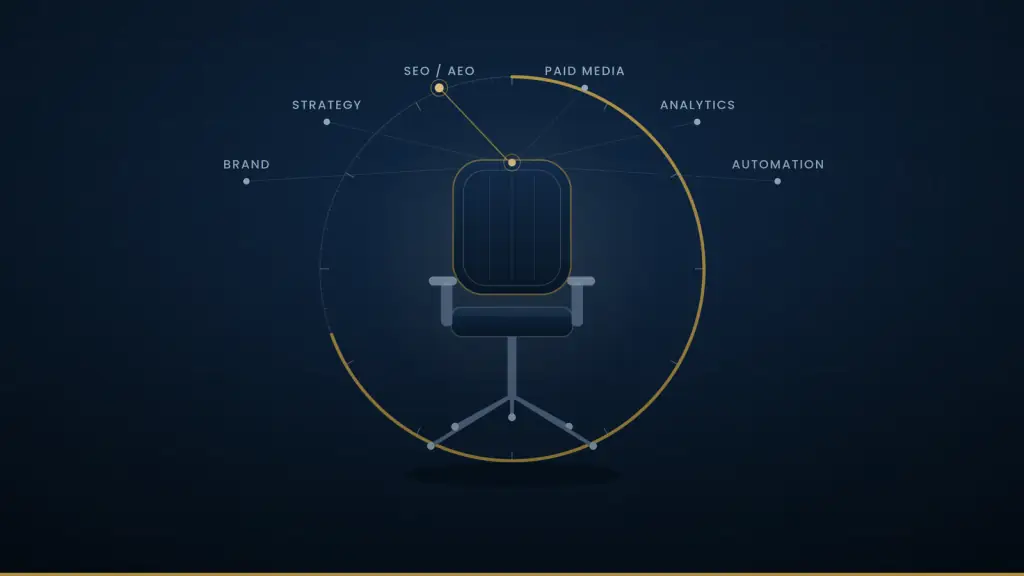
Senior marketing leadership and execution for growth-stage service businesses.
Explore Fractional CMO & Marketing Leadership →
Google Ads and paid media managed against revenue and CPA targets.
Explore Paid Media & Google Ads →
WordPress on WP Engine plus CRM, automation, and conversion tracking.
Explore Web Development & Marketing Technology →SEO & AI Search (GEO/AEO) across 20 communities in 20 regions — grouped below, with a dedicated page for each city.